Plaque de talon de pneu en PP : évolution du « tampon d’isolation » au support de processus de précision
In the manufacturing process of radial tires, after the steel wire ring and apex rubber are rolled and bonded together, they must undergo temporary storage, multi-layer stacking, and automated transportation before entering the tire blank forming station. The core fixture used in this process to prevent the adhesion of uncured rubber, maintain the geometric accuracy of the tire bead, and adapt to the gripping of the robotic arm is commonly referred to as the tire bead separator in the industry. The mainstream use is PP tire bead separators (also known as triangular rubber shaping discs, Beam Spacer/Apex Discs) that are injection molded from polypropylene.
1、 The process intention behind the structural details
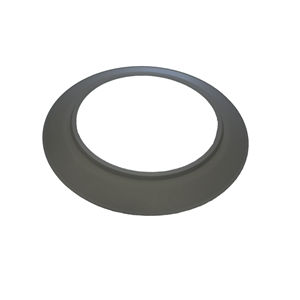
The high-quality PP tire bead partition is not a flat disc, but a topologically optimized imitation injection molded part:
Imitation inner cavity and positioning ribs: The disc edge is flanged upwards to form a receiving cavity, and the inner wall is equipped with 1-2 rings of annular convex ribs. The curvature of the curved surface is precisely matched according to the tire section (corresponding to different wheel specifications of car tires/light trucks/all steel load tires). After placing the triangular rubber, uniform constraints are applied to the rubber ring to counteract the stress relaxation and rebound of the uncured rubber and maintain roundness.
Central through-hole and bottom protrusion: The central large aperture is used for inserting or dissipating the positioning pin of the robotic arm, and protruding positioning parts are set around the bottom through-hole to interlock with the central hole of the upper partition, ensuring automatic stacking accuracy.
Radial reinforcement ribs: Reinforcement ribs are arranged at the bottom of the disc to enhance overall rigidity and prevent indentation. At the same time, small airflow channels are left between the partitions to assist in heat dissipation and reduce the risk of early burning of the triangular adhesive.
2、 Why is it modified polypropylene (PP)
Traditional fiberboard absorbs moisture and debris, contaminating the rubber material. Metal trays are bulky and prone to scratching the rubber surface. PP tire bead separators have become mainstream due to their material properties
Low surface energy anti sticking: PP has high crystallinity and low surface energy, weak affinity with uncured bead rubber containing aromatic hydrocarbon operating oil, small contact area, and is not easy to adhere. There is basically no residual rubber when demolding.
Dimensional stability without water absorption: The water absorption rate is extremely low, and the thickness tolerance can be stably controlled within ± 0.05mm under fluctuations in workshop temperature and humidity, ensuring controlled stacking eccentricity.
Heat resistance and toughness balance: After adding impact modifiers to co polymerized PP, the Vicat softening point is usually adjusted to 135-145 ℃, which can withstand short-term thermal radiation around the vulcanization zone and maintain rigidity; The cantilever beam has high impact strength and is suitable for high-frequency grasping by robotic arms, making it less prone to brittle cracking.
Lightweight, clean and recyclable: with a density of about 0.90g/cm ³, weighing over 100 grams per piece, the surface is smooth without fiber shedding, and can be reused dozens to hundreds of times after cleaning.
3、 On site use value and management
In the production line, the bead separator serves three essential functions: isolating and stacking beads to prevent mutual adhesion and indentation; By constraining the shape of the tire bead through the contour cavity, the workload of calibration during molding is reduced; Cooperate with the automatic stacking system to provide vacuum suction cups or grippers for gripping, improving the reliability of unmanned operation.
When using, attention should be paid to selecting the corresponding curved surface model according to the diameter of the bead wire and the height of the triangular rubber. Improper use can cause local compression and affect tire uniformity. PP will gradually age and turn white or develop microcracks due to long-term heating and bending, and obvious warping and edge damage should be eliminated in a timely manner. It is recommended to rinse with deionized water and store in the shade to avoid long-term direct sunlight (UV stabilizer can be added to modify the brand), which can delay photo oxidative aging and extend the service life.
As a low-key high-frequency cycling accessory for tire factories, PP bead separators have triple values of contour shaping, anti sticking isolation, and automation compatibility, directly participating in ensuring the accuracy of bead size and the uniformity of finished tires. Standardized selection and regular replacement of tire bead separators are management measures that are easily overlooked but highly cost-effective in reducing the rate of defective products.
Changshu Yongchengsheng Hardware Products Co., Ltd. specializes in the production and sales of tire bead separators and PP tire bead pads. If you need them, please contact us at+86-13506249539; Contact email: ljd706627@gmail.com